

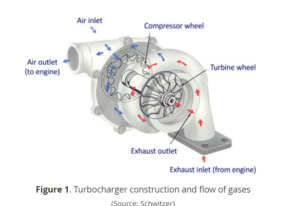
A turbocharger is a device that connects a compressor wheel and an exhaust gas turbine wheel through a solid shaft to enhance the intake air pressure of an internal combustion engine. The exhaust gas turbine captures energy from the exhaust gas and uses it to power the compressor and reduce friction. Radial flow is present in both the compressor and the turbine wheel in most automotive-type applications. A radial flow turbine wheel can be used instead of an axial flow turbine wheel in some circumstances, such as medium- and low-speed diesel engines. Figure depicts the flow of gases through a conventional turbocharger with a radial flow compressor and turbine wheels.
Center-Housing
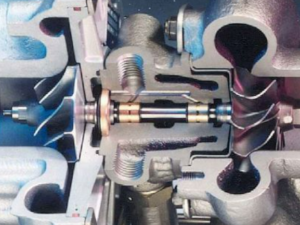
The turbine-compressor common shaft is supported by a bearing system in the centre housing located between the compressor and the turbine (Figure). The shaft wheel assembly, also known as the rotating assembly, is the shaft with the compressor and turbine wheels connected. The centre housing rotating assembly is SWA placed in the centre housing but lacking the compressor and turbine housings. The centre housing is typically made of grey cast iron; however, aluminum can be used in some situations as well. Seals prevent oil from entering the compressor and turbine. Turbochargers designed for high exhaust gas temperature applications, such as spark ignition engines, might have cooling channels in the central housing.
Bearings
The turbocharger bearing system looks to be basic in design, yet it is important to several critical operations. Two of the most important are controlling the radial and axial motion of the shaft and wheels, as well as minimizing friction losses in the bearing system. Bearing systems have attracted a lot of attention because of their impact on turbocharger friction and engine fuel efficiency.
Except for very large turbochargers for low-speed engines, the bearings that support the shaft are typically located between the wheels in an overhung position. This adaptable rotor design guarantees that the turbocharger operates beyond its first, and potentially second, critical speeds, and is therefore susceptible to rotor dynamic situations such as whirl and synchronous vibration.
Seals
Both ends of the bearing housing have seals. Because of the requirement to keep frictional losses low, the relatively significant shaft motions owing to bearing clearance, and unfavorable pressure gradients under particular situations, these seals offer a tough design issue.
These seals primarily block intake air and exhaust gas from entering the central housing. Pressures in the intake and exhaust systems are often higher than pressures in the centre housing of the turbocharger, which is normally at engine crankcase pressure. As such, they would be designed primarily to seal the centre housing when the pressure in the centre housing is lower than the pressure in the intake and exhaust systems. These seals are not meant to be the major way of keeping oil from leaking from the centre housing and into the exhaust and air systems. Other methods, such as oil deflectors and spinning flingers, are generally used to keep oil from touching these seals.
Turbocharger seals are not the same as soft lip seals used in rotating machinery that operates at considerably lower speeds and temperatures. One form of seal that is frequently utilized is the piston ring seal. It’s composed of a metal ring that looks like a piston ring. The seal remains stationary while the shaft spins. The labyrinth seal is another form of seal that is infrequently employed. In general, turbocharger shaft seals will not prevent oil leakage if the pressure difference reverses, resulting in pressure in the centre housing being higher than pressure in the intake or exhaust systems.
Useful links
Visit eBay to buy remanufactured turbochargers.
Buy best remanufactured turbochargers on precisionturbos.co.uk.
Remanufactured Turbo Specialists NOT Reconditioned Turbos (precisionturbos.co.uk)
Audi A4/ Q5 Turbo BorgWarner BV43 5303 970 0190 CAGA/CMEA/CJCA


