

For many years, turbochargers have been the golden standard of power improvements, pushing engine blocks to their breaking points with increased horsepower and heat production. With famous vehicles such as the Mazda RX-7 and Ferrari F40 boasting not one, but two turbochargers, it’s time to take a look at how twin-turbocharging operates and the many types available on the market.
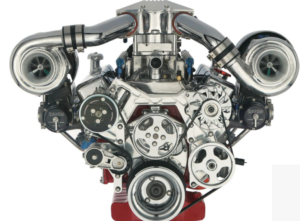
It’s about as standard as twin-turbocharging gets, with two turbochargers of the same capacity working together to pump air into the cylinders as rapidly as feasible. The exhaust gases recycled to the turbos are split evenly between the two, but they often combine again at a shared inlet before reaching the cylinders.
The advantage of this simple system is that it has the potential for significantly less turbo lag than a single massive turbocharger doing most of the work. In V-engines, each turbocharger is typically assigned its bank of cylinders, rather than one huge turbocharger forcing air through complex plumbing to reach the required cylinders. The absence of latency is partly caused by the tradition of using somewhat smaller turbochargers when parallel twin-turbocharging, rather than one huge turbocharger with larger vanes.
To maintain these benefits while balancing the power demand, parallel turbos should be set at pretty modest boost pressure to prevent turbo latency, but with the integration of the two turbines producing enough power.
Sequential twin-turbos
This configuration makes use of two turbochargers of various sizes: a small-vaned turbo for limited exhaust manifold at low engine speeds, and a much larger second turbo to take over after the first has had a chance to spool up.
A compression valve is located next to the large turbocharger, ensuring that all of the reduced energy exhaust gases produced at the underside of the rev range are isolated to the relatively small turbocharger, maximising power delivery at a rev range previously unavailable to most single turbocharger setups. As the engine speed increases, the compression valve gradually opens, allowing the bigger turbine to begin to spool. The valve is then prompted to fully open at a predetermined volume of airflow, letting the secondary turbo operate at peak efficiency.
As a consequence, sequential turbocharging eliminates virtually all of the drawbacks of single turbocharging and surpasses parallel configurations since the secondary turbo may be set to extremely high boost, counting on the prime turbo to eliminate any latency lower down. Car tuners may also get quite creative with a sequential system, adjusting the ratio between the tiny and large turbochargers to produce some truly terrifying power outputs. Consider the MkIV Toyota Supra to be arguably the best framework for sequential turbocharging.
Useful links
Visit eBay to buy remanufactured turbochargers.
Buy best remanufactured turbochargers on precisionturbos.co.uk.
Remanufactured Turbo Specialists NOT Reconditioned Turbos (precisionturbos.co.uk)
Mazda 3 6 CX5 CX7 Twin Turbo Bi Turbocharger 2.2d 810356 810358 150HP 188HP


