

Turbos Lag Behind
The traditional advantage of a belt-driven supercharger is that it responds instantly when you slam the throttle because it is directly connected to the crankshaft. A large supercharger, on the other hand, necessitates a significant amount of power. Driving a Top Fuel dragster’s 14-71 Roots blower requires 900 to 1,000 crankshaft horsepower at 65 psi of boost. Because of exhaust path restrictions, an efficiently designed turbocharger exhaust system consumes much less power at an equivalent performance level. The main issue with turbochargers is the time lag between when the accelerator pedal is opened and when it is closed. The more powerful the turbo, the greater the lag. A small turbo can reduce lag, but at the expense of top-end power. A turbine with VGT, which expands the turbine’s low- and high-end efficiency package, is still a balance. Another option is to run several smaller turbos in parallel, or even several turbos in series. This increases the cost and ambiguity.
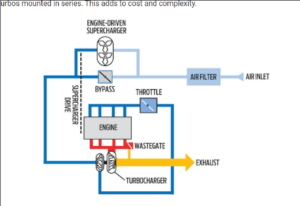
Volkswagen even produced a 1.4L engine with a turbocharger as well as a belt-driven supercharger, which provided an instant response from the supercharger and top-end power from the turbocharger. This engine, known as the VW “Twincharger,” produced more torque than a 2.3L naturally aspirated engine while using 20percentage points less fuel. Admittedly, the engine was expensive to produce because it had both a turbo and a supercharger. Despite a slight drop in overall performance, VW eventually replaced it with a less expensive single turbocharger.
The next step in combating turbo lag is to replace the auxiliary belt-driven supercharger with a simple electrically driven supercharger that works in tandem with a turbocharger. BorgWarner’s eBooster system, for example, eliminates turbo lag and allows for turbo sizing for peak power. The Mercedes-Benz 3L S-class engine will be the first commercially available application for the eBooster in 2021. An advanced brushless DC ultra-high pace electric motor powers the supercharger.
An effective interim solution, an “extra” supercharger—whether belt- or electric-driven—takes up a lot of packaging space because it integrates the additional hardware into the existing powertrain; two devices are heavier, larger, and more costly than one. There is still no power regeneration capability, the electrical power demands are nevertheless high, and it does not address the power of “wasted” potential energy bypassed by the wastegate and exited through the exhaust.
Exhaust Waste Heat Is Lost Potential Energy
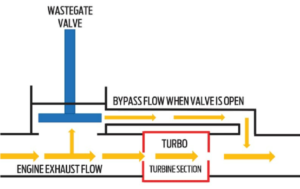
To control the amount of boost on a turbocharger, a “wastegate” is used. A wastegate is a valve that opens upstream of the turbocharger to allow heat energy to bypass the turbocharger and go directly to the exhaust. This prevents the turbo from producing too much boost or losing efficiency by going into “Overspeed”Take note of the word here: wastegate. That’s correct. Potential heat energy is “wasted” or lost out the exhaust when a wastegate opens. That’s a waste of time. Engineers despise inefficiency, but on an internal combustion engine, “waste heat” was just something you accepted.
Useful links
Visit eBay to buy remanufactured turbochargers.
Buy best remanufactured turbochargers on precisionturbos.co.uk.
Remanufactured Turbo Specialists NOT Reconditioned Turbos (precisionturbos.co.uk)
ALFA ROMEO MITO 312A2000 2011 0.9P 84HP 49373-30312 49T73-03012 TD02H2-07TVT-2.7


