

Induction by Forcing
Increased engine displacement is an apparent technique to gain more engine power. Allison V-1710 engines had a capacity of 1,700 cubic inches at the start of the conflict. They had a horsepower rating of around 1,000. Toward the conclusion of the war, the huge Pratt & Whitney R-2800 featured 2,800 cubic inches of capacity and provided double the power of the early Allison.
However, Stanley Hooker, who oversaw the development of superchargers at Rolls-Royce, emphasized that gas mileage alone is deceptive when it comes to power. The ability to efficiently supply the engine with air and fuel is also essential. This was accomplished using forced ignition and high-octane gasoline. They essentially provided a greater engine displacement.
The air becomes thinner as altitude climbs. At 18,000 feet, for example, air density is half of what it is at sea level. Lower air density isn’t always a negative thing. As an airplane rises, it decreases air resistance, causing level speed to increase for given engine power. However, decreasing air density decreases the amount of oxygen required by the engine to burn fuel. Low air pressure is more sign up to a certain altitude, and a spacecraft’s level speed increases as altitude increases. However, above this height, power loss takes over and level speed diminishes. This is appropriately referred to as the “critical height.”
Ww2 jet aircraft used forced intake, which condensed the oxygen preceding mixing it with fuel, to compensate for decreased air density at higher altitudes.
The thinning air would finally triumph. However, owing to forced induction, the aircraft’s new critical altitude was far higher, and performance at altitude was significantly better.
Forcing even more air into the cylinders would also enable more gasoline to be pumped in, enhancing engine power above its normal sea-level number. Even at low altitudes, this would improve engine performance. At typical temperatures, air pressure is 15 pounds per square inch.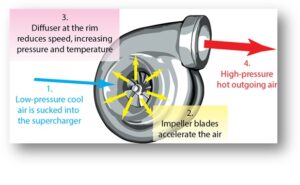
The Cycle of Forced Induction
Figure 1 depicts the operation of forced induction. A fast rotating impeller draws in airflow in the fuel injection device. The impeller centrifugally accelerates the entering air from the center to the chamber’s periphery. Despite the fact that the air at the rim is traveling at near-lightspeed, it does not rise in high and low pressure.
Fixed diffuser vanes near the chamber’s edge slow the air, as seen in Figure 2. Following Bernoulli’s principle, as the air slows, its pressure rises. The air now has the density required by the engine.
Useful links
Visit eBay to buy remanufactured turbochargers.
Buy best remanufactured turbochargers on precisionturbos.co.uk.
Remanufactured Turbo Specialists NOT Reconditioned Turbos (precisionturbos.co.uk)
Volvo V60 V70 S80 XC60 XC70 2.4d Twin Turbo D5 53169700017 54399700091


