
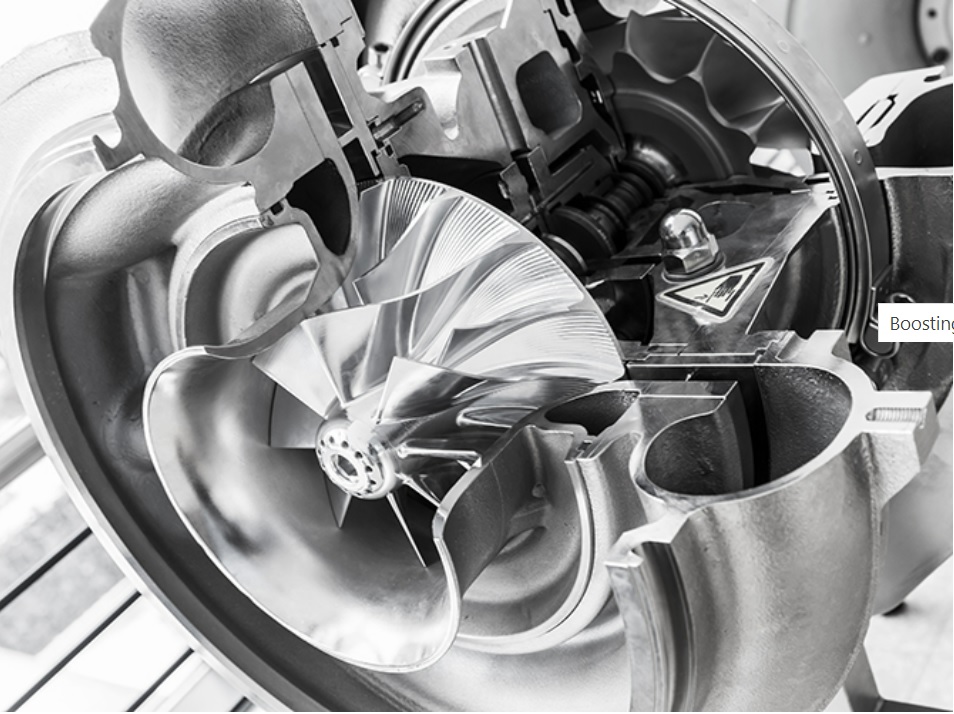
The turbo actuator serves a simple but important purpose: it acts as a pressure relief valve, controlling boost output while directing surplus exhaust gases away from the turbine wheel. This regulates the compressor’s speed and limits the turbine’s speed, preventing it from overspending. Finally, restricting the maximum boost pressure of the turbocharger at a safe level helps to safeguard the turbocharger from needless wear and tear.
Objectives:
- The turbo actuator has a simple but important function: it acts as a pressure relief valve, regulating your turbo’s boost output and directing excess exhaust gases away from the turbine wheel. This controls the speed of the turbine and regulates the speed of the compressor, preventing it from over speeding.
- Controls the variable geometry turbocharger’s nozzle opening and shutting. To optimize high torque at low speed, fuel efficiency, and acceleration performance, the nozzle opening angle is controlled based on the rotation level.
Working of wastegate actuator:
A wastegate actuator is a simple piece of equipment that consists of a spring and a diaphragm. The spring holds the wastegate closed until the boost pressure reaches a certain level, at which time it releases, allowing the gas to escape and decreasing the boost pressure.
The wastegate actuator internal diagram is shown in fig (1).
Controlling methods:
There are two common approaches for controlling the wastegate. The tried-and-true first
approach is to employ a boost-operated canister (also known as a “can”). These Cans are intended to operate in a specific boost range, say 10 to 20 psi. A classic Can is made up three main parts and their detail is given below;
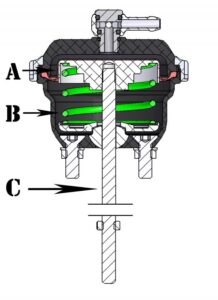
A: Diaphragm – A seal on the diaphragm prevents boost pressure from leaking.
B: Spring – The spring in a Can provides the force to keep the wastegate shut.
C: Actuator Rod – A rod connecting the wastegate actuator arm to the diaphragm.
The actual amount of boost pressure required to overcome the spring depends on how much the spring has been compressed. When the boost force exceeds the spring force, the spring begins to compress, forcing the actuator rod to move and the gate to open.
Turbosmart has just released its new IWG HP. These wastegate actuators are available in a range of boost pressures ranging from 10 to 40 psi. “Turbosmart’s Internal Wastegate actuators are great in a wide range of diesel applications,” says Marty Staggs, Turbosmart USA’s Executive Vice President/General Manager.
The second and more modern technique of regulating the wastegate is via a spring regulator. Although many aftermarket businesses use spring-controlled actuators, OEM turbochargers do not. A continuous compression spring is used in these drive pressure regulators. The force produced by the spring is the force that keeps the wastegate closed. The wastegate is activated by using the engine’s driving pressure. As the drive pressure increases, the pucks are pushed up. The wastegate begins to open when the force of the driving pressure surpasses the spring pressure. This type of regulator controls boosts by adjusting the driving pressure.
Useful links
Visit eBay to buy remanufactured turbochargers.
Buy best remanufactured turbochargers on precisionturbos.co.uk.
Remanufactured Turbo Specialists NOT Reconditioned Turbos (precisionturbos.co.uk)
AUDI A4 2.7d Turbo Garrett GTB17V VNT CAMA/CGK 777159 With Electronic Actuator


